Skip to content


Table of Contents
Hair loss tends to be a slow, quiet process until one day it isn’t. You notice the thinning in the part, the extra strands in the shower drain, and suddenly you’re doing research at midnight. If you’ve come across platelet-rich plasma therapy as a potential option, you probably have one main question: how many sessions will it take before you actually see results?
The honest answer is that most patients need an initial series of three PRP sessions for hair restoration, spaced five to six weeks apart, followed by maintenance appointments every four to six months. That’s the general roadmap, but there’s more to understand about what drives results and why the timing matters.
What does a typical PRP hair loss treatment schedule look like?
Most patients need three initial PRP sessions for hair restoration spaced five to six weeks apart, followed by PRP maintenance treatments every four to six months to preserve results. The number can vary based on the degree of hair loss, how well the follicles respond, and individual health factors, which is why a personalized evaluation at a dermatology practice like Sheperd Integrative Dermatology is the best starting point for building a realistic plan.
How PRP Actually Works for Hair Loss
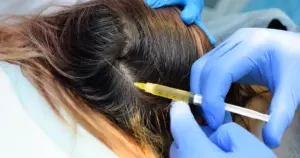
Platelet-rich plasma therapy uses your own biology to support hair follicle health. A small amount of blood is drawn from your arm and placed in a centrifuge, which spins it down to concentrate the plasma and its growth-promoting components. That concentrated solution is then delivered to the scalp via microneedling or targeted injections, thereby reaching the follicles directly.
The mechanism isn’t complicated, but it is meaningful. Hair follicles that have begun to shrink due to androgenetic alopecia or other causes can sometimes be revived, or at least slowed in their decline, when exposed to this concentrated plasma. For some patients, the result is reduced shedding. For others, there is noticeable regrowth in areas that had become sparse. PRP doesn’t reverse every case of hair loss, but the evidence supporting its use for follicle health is solid enough that it has become a meaningful option in hair restoration treatment.
The Initial Treatment Series: What to Expect
At Sheperd Integrative Dermatology, the standard starting protocol involves three sessions, each about five to six weeks apart. That spacing is intentional. The scalp needs time to process each treatment and respond before the next round.
Most patients don’t notice dramatic changes after the first session, which is completely normal. The process is cumulative. By the second and third appointments, many people begin to see reduced shedding and some new growth along the hairline or in thinning areas. Results continue to develop for several months after the series is complete, so patience is part of the plan.
A few things can influence how the initial series goes:
- The extent and pattern of your hair loss
- How long has the thinning been occurring
- Your overall health and any underlying factors contributing to loss
- How well your blood responds to the centrifuge process (platelet concentration varies person to person)
None of these are reasons to avoid PRP, but they do affect the timeline and the aggressiveness of the treatment plan.
Why Maintenance Matters
This is the part that surprises some patients. After the initial three sessions, PRP isn’t a one-time fix. To maintain results and support follicle health, most people need a PRP maintenance treatment every four to six months.
Think of it this way: PRP doesn’t change the underlying genetic or hormonal factors driving hair loss. It gives your follicles a recurring boost that helps them stay active and healthy. Without maintenance, the effects from the initial series will gradually fade, and the hair loss progression can resume.
Sticking with a maintenance schedule is one of the clearest predictors of long-term satisfaction with PRP. Patients who come in consistently for their follow-up sessions tend to hold their results much better than those who stop after the initial series.
Who Tends to Respond Well to PRP
PRP works best when viable follicles are still present. It’s most commonly used for androgenetic alopecia, which is the pattern hair loss that affects both men and women. It’s also used in cases of alopecia areata and other conditions where inflammation or poor follicle health is a contributing factor.
Patients who are earlier in the hair loss process generally see more dramatic results because there’s more to work with. That said, PRP can still be useful for people with more advanced thinning, particularly to slow further loss and support the hair that remains.
A thorough consultation at Sheperd Integrative Dermatology will include a scalp evaluation to determine whether PRP is the right fit and what a realistic outcome looks like for your specific situation. That evaluation is also the right time to ask about combining PRP with other treatments, since it is sometimes used alongside topical therapies or other in-office options to support a more complete hair restoration treatment plan in Mount Pleasant, SC.
Building a Plan That Fits Your Goals
There’s no single answer that works for every patient. Some people complete their initial three sessions and are thrilled with the results they sustain through twice-yearly maintenance. Others may benefit from a slightly different cadence depending on how their scalp responds. What doesn’t vary is the importance of following through. Starting PRP and stopping after one session leaves the work incomplete and makes it hard to evaluate whether the approach is actually working.
Moving Forward with PRP at Sheperd Integrative Dermatology
If you’ve been watching your hairline change and wondering what your options are, PRP is worth a real conversation. It’s a biological approach; it uses your body’s resources, and the treatment protocol is manageable for most schedules. The key is to set realistic expectations up front and commit to the full plan.
Build your customized hair growth plan today! Contact Sheperd Integrative Dermatology to schedule your consultation. Our team will evaluate your hair loss, walk you through what PRP can realistically offer, and help you put together a plan that makes sense for where you are right now.